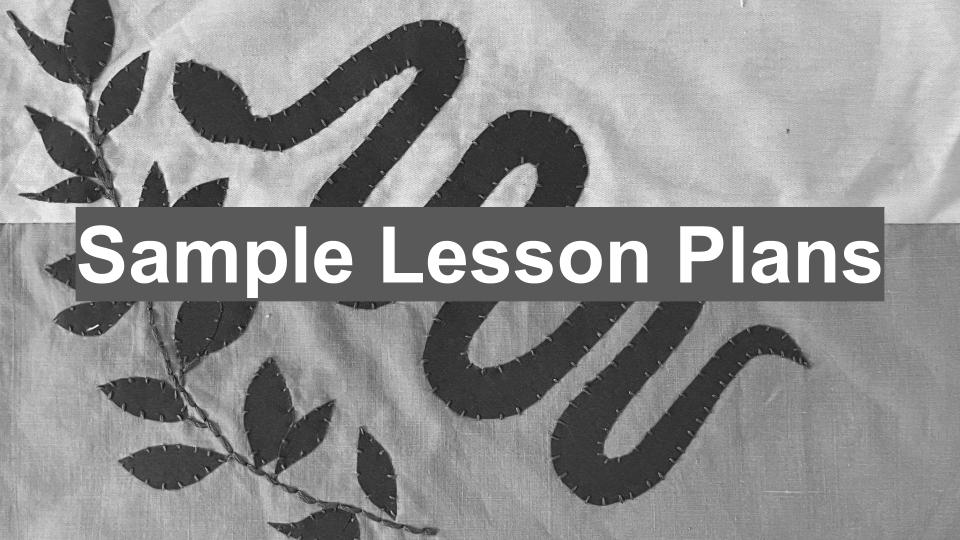
High School Lesson Plan Sample
Flags: Visualizing Values
Overview: Students will make their own flags inspired by the work of contemporary artists who produce flags or are inspired by flags in their artwork. Students will be prompted to create a flag that symbolizes an ideal, belief, or desire of theirs. Students can decide if their flag represents a group or nation that already exists or one that they imagine or hope will exist someday.
Big Idea: Symbolizing Values
- Key Concepts:
- Flags as symbols and signs
- Representing a collective or group
- Imagining futures
- Essential Questions:
- How are flags used to represent ideals?
- What do flags symbolize?
- What is an ideal you want to symbolize?
Rationale: Commonly flags symbolize or represent groups with shared interests of values. Flags are symbolic of borders, nations, and affiliations. In this unit, the goal is for students to think critically about what flags have the possibility to symbolize when they are not limited by their connections to land and borders.
Target Student Group: Highschool Art 2 class following a unit on embroidery.
Cultural Responsiveness: Flags are used globally, artworks highlighted in this unit will be from artists of several backgrounds who make work related to interpreting flags.
Specific Objectives: Students will learn how to use a sewing machine to piece fabric for the background of their flags, and how to hand appliqué fabric onto their pieced backgrounds. Students will employ principles of design such as balance and harmony when planning out their flags.
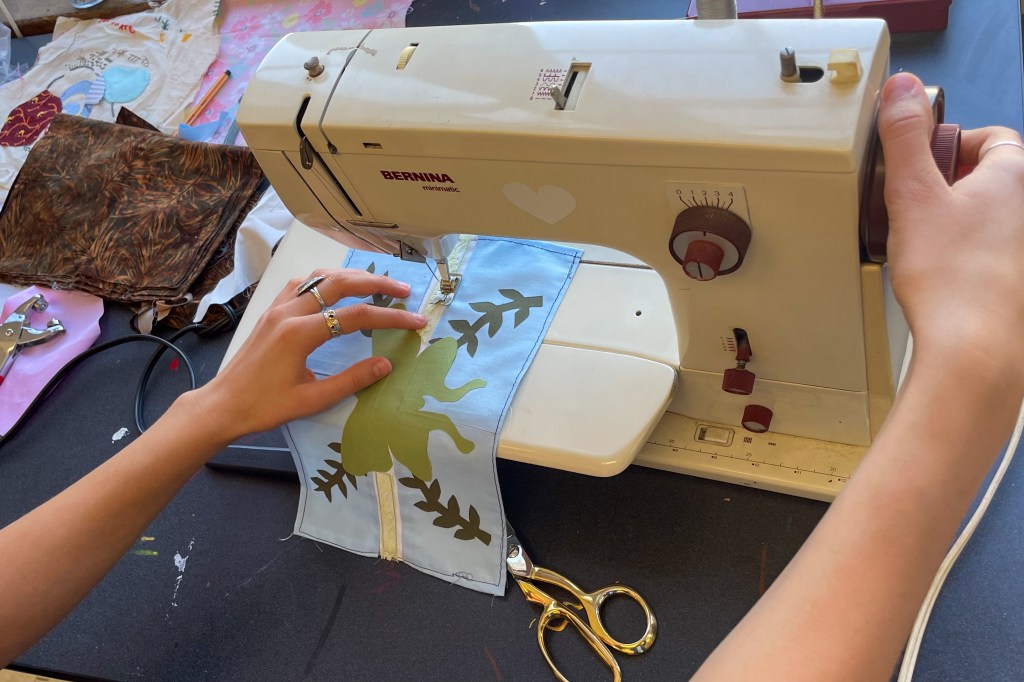
Lesson 1– Flags as Symbols
Objective: Students will learn about contemporary artists who use flags in their artwork and discuss the purpose of flags in our society. Students will sketch out and design their own flag that symbolizes their beliefs, selecting at least 1 symbol and at least 2 colors. After having a sketch approved they will select fabric for their flags.
Assessment: Students will have completed sketches and filled out a worksheet to justify their color and symbol choices.
Lesson 2- Sewing Flags
Objective: Students will translate their sketches into fabric flags after learning how to use the sewing machine to piece the backgrounds, they will then glue and sew on their symbolic element by hand.
Assessment: Students will sew at least 2 pieces of fabric together using the sewing machine and attach their symbolic element with glue and hand stitching.
Lesson 3- Critique & Self Assessment
Objective: After students have completed their embroideries and flags, and have received a self-assessment, students will be able to identify improvements made from their first embroidery to their flag, as well as their project’s strengths, and weaknesses. Students will also be guided through small group written critiques using sentence starters to give their peers constructive feedback.
Assessment: Students will complete their self-assessments and participate in the small group written critiques. Students will turn in their flag with the written feedback they received so the instructor can gauge the effectiveness of the critique.
National SOLS: VA:Cr2.1.IIa: Through experimentation, practice, and persistence, demonstrate the acquisition of skills and knowledge in a chosen art form.
Elementary Lesson Plan Sample

Communication & Correspondence: Mail art, Posters & Zines
Overview: In this Unit, Students will look at examples of mail art, zines, prints and artist books and discuss their significance as an art medium. Students will learn how to make their own prints and talk about how the creation of multiples of an artwork might change its value. Students will create mail art meant to be given away to someone they know outside of their class. Students will also produce their own zines or artist books to contribute to the class library. Through the exploration of these mediums, students will learn to identify the desired audience of their artworks and learn about how to best communicate their ideas to this audience. Students will also have the chance to consider the significance of gifting their artworks to others. They will have the opportunity to examine mass-produced images like posters and logos and consider what makes them effective, increasing visual literacy. Through learning about mail art, artist prints, and zines, students will gain exposure to three new art forms that emphasize a direct connection between an artist and their audience.
Essential Questions
- What purpose do books, mail, magazines and posters serve?
- What do these things have in common?
- Why would an artist make books, mail, magazines and posters?
- What happens when we produce multiples of something? How does this change its value?
- How is your artwork affected if you know it will be shared and distributed?
Key Concepts
Students will learn about bookmaking, mail, zines and posters as a form of art and communication.
Students will create with the intention of giving their artworks away. Students will consider the role of text and image as a way to communicate their chosen “message.”
Rational: Through this unit, students will grow comfortable with the concept of making art to be given away. Students will gain experience creating art as a form of communication meant for a specific audience, mimicking the practices of professional artists. This exercise will grow students’ interpersonal skills and allow them the chance to practice generosity, making them better communicators in the future. The unit will also allow students to experiment with new media, collage, printmaking, and zine-making, expanding their artistic vocabulary.
Target Student Group: 5th Grade
Cultural Responsiveness: Techniques will be varied throughout the unit. Artworks and artists discussed in class will be contemporary and demonstrate diverse perspectives. Examples given in the Zine lesson will be multilingual including zines in Spanish and Arabic. Students will have the chance to express their own cultural points of view in their artworks. For students with IEPs Instruction will be provided verbally, through demonstration, and in written format. Directions will also be given one step at a time. Pair and share will also be utilized before large group discussions.
OBJECTIVES AND ASSESSMENT:
Students will learn about mail art, posters and zines as an artform and why artists make work in a format that is meant to be given away and distributed. Students will create their own mail art, zines and relief prints during this unit and have the opportunity to share them with others. Students will demonstrate an ability to execute their plans by working with mixed media, collage, prints and paper
Lesson/Day 1: Unit intro: Mail Art
Objective: Students will see examples of and learn about Mail Art, Posters and Zines. They will have the chance to discuss how these mediums are connected through themes of communication and the intention of informal distribution. Students will be given collage materials to create their first piece of mail art to be given to someone outside of their class. Students will receive a brief history about mail art and a few contemporary projects before they begin working.
Assessment: Checklist: Students will identify who their mail art is for, create one piece of collaged mail art using at least 4 different pieces of collaged materials.
Lesson/Day 2: Posters: relief printing
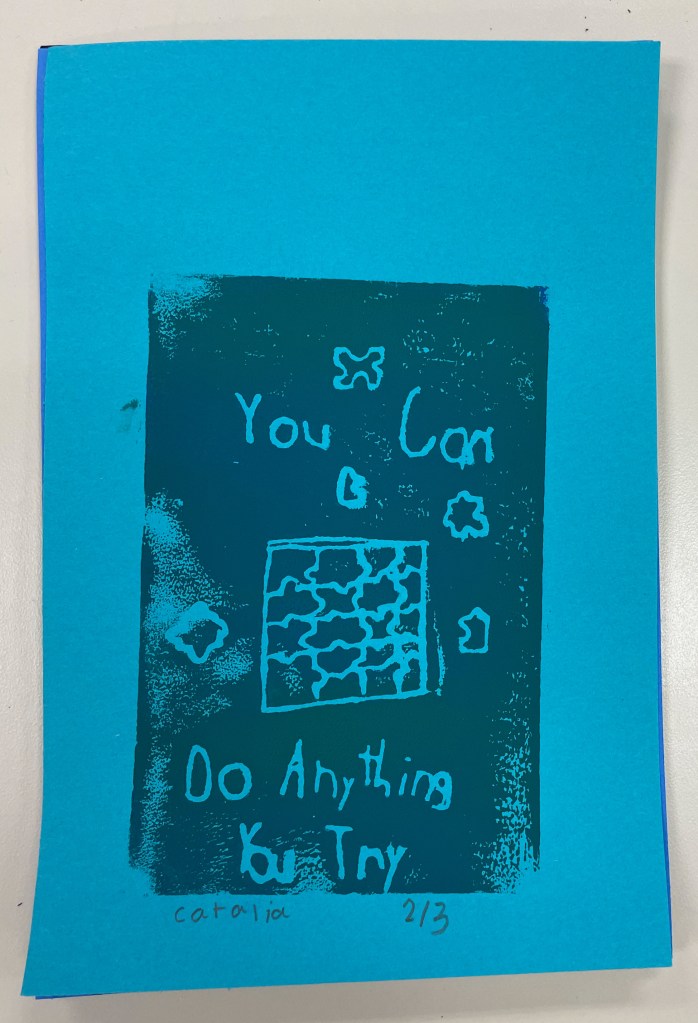
Objective: Students will learn about art posters and multiples. Through relief printing processes students will have the chance to create multiples of their artworks to be distributed and given away. Students will look at artist’s examples of posters and prints and talk about how the value of an artwork changes when it is a part of a series. Students will learn how to create a print and the best practices for using printing materials (foam print).
Assessment: Students will demonstrate the relief printing technique by creating two printing plates with designs that communicate a message of their choice.
Lesson/Day 3: Posters part 2:
Objective: This day of the lesson will focus on printing methods, having already made their printing plates out of foam in the previous class.
Assessment: Students will create at least 5 prints, experimenting with different colors of ink and at least 2 different background colors.
Lesson/Day 4: Zines & Artist books
Objective: Students will learn about artist zines and artist books and their historical background pointing to political movements, illustration, information, and storytelling. After looking at examples, students will learn how to make Magic Zines and will create a plan for the content of their own zine. Students will conclude the class with a gallery walk where their classmates can walk around and look at everyone’s zines.
Assessment: Students share their zines as a class, and share characteristics in their classmates’ work that they admire. Self-assessment: “2 Glows, 1 Grow”
National Visual Arts Standards: VA:Cr2.1.5a: Experiment and develop skills in multiple art-making techniques and approaches through practice. VA:Cr2.2.5a: Demonstrate quality craftsmanship through care for and use of materials, tools, and equipment.
KEY VOCABULARY:
Communication: How we speak or write to each other and then listen and respond.
Correspondence: an ongoing conversation or stream of communication between at least two individuals
Distribution: to deliver, disperse, spread (an artwork, mail, publication)
Zine: a small independent publication or booklet
Mail Art: an art movement based on the idea that you can send anything in the mail.
Print: The result of a printing process often resulting in multiples.
Relief print: Printing through the process of creating a carved image on a surface like foam or linoleum then inking that surface and using it like a stamp to create an image on paper.





 Lizzie Green